
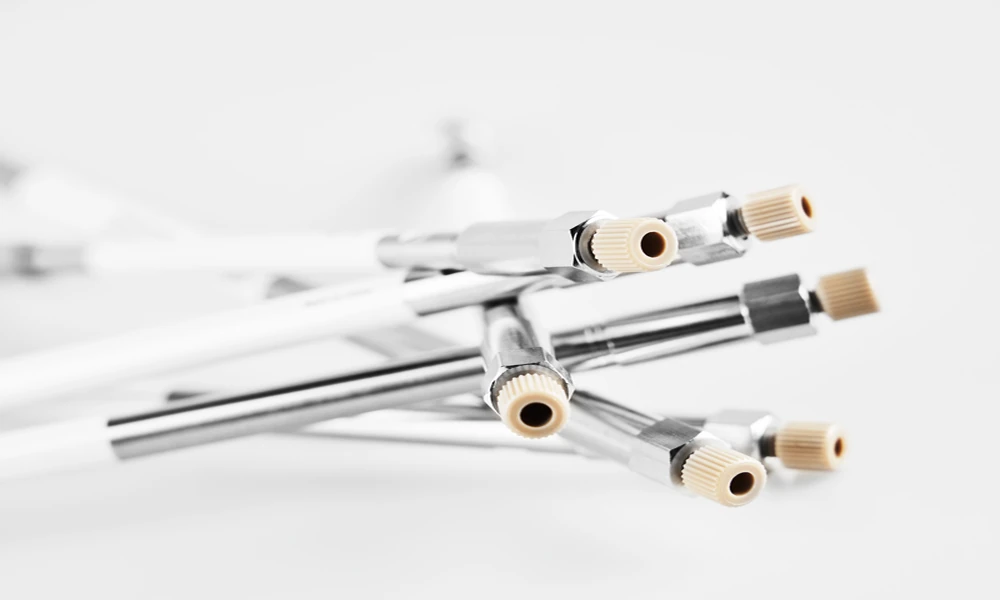
A chromatogram can look clean and still hide a problem. Two compounds that are mirror images of each other often behave almost identically on a standard column. If they are not fully resolved, the peak that appears as one substance may contain both. Downstream calculations then rest on an incomplete picture.
This is why the choice of chiral columns remains a decisive step in many analytical workflows. When stereochemistry affects biological activity, impurity profiles or regulatory acceptance, incomplete separation introduces uncertainty that no amount of later data processing can fully remove.
How column choice shapes data trustworthiness
A suitable chiral stationary phase creates differential interaction between the two mirror-image forms. One form is retained longer than the other. When the difference is large enough and the peak shapes remain usable, the chromatogram shows two distinct signals instead of one. Quantification and identification become possible on each form separately.
Consistency across batches and over time matters as much as the initial separation. A phase that delivers clear resolution on one day and partial overlap on another undermines the reliability of trend data. Laboratories therefore look for phases whose behaviour remains predictable under the conditions they actually use. The search is rarely dramatic. It is mostly about avoiding quiet drift.
Simple comparison of phase types
| Phase category | Typical use case | Strength | Limitation to watch |
|---|---|---|---|
| Coated polysaccharide | Broad screening of many compound classes | Wide enantioselectivity | Solvent restrictions in some cases |
| Immobilized polysaccharide | Methods needing stronger solvents | Greater solvent flexibility | Sometimes lower selectivity than coated |
| Protein-based | Specific biomolecule separations | High selectivity for certain pairs | Narrower applicability range |
| Brush-type / other specialty | Targeted or complementary separations | Useful for difficult pairs | Often more specialised method development |
The table is a starting orientation rather than a selection guide. The right phase is the one that delivers stable resolution for the specific compounds and conditions in use. No more, no less.
Removing uncertainty before it spreads
Once a reliable separation is in place, several downstream risks decrease. Impurity profiles become clearer. Comparative studies rest on better-defined materials. Method transfer between instruments or sites encounters fewer surprises related to peak identity.
Laboratories that treat chiral columns as a foundational decision rather than a late-stage fix usually spend less time troubleshooting ambiguous results. The separation quality is established early. Later work inherits that clarity instead of having to compensate for its absence.
Consistent separation removes one major source of downstream uncertainty. The chromatogram becomes a more trustworthy record of what is actually present. Every calculation that follows rests on firmer ground. Or at least on ground that is no longer quietly shifting.

Comments are closed.